Within the past century, crystallography has been a primary force in driving major advances in the detailed understanding of materials, synthetic chemistry, the understanding of basic principles of biological processes, genetics, and has contributed to major advances in the development of drugs for numerous diseases. It is one of the most important tool to study solids, since most of the materials in solid state exhibits crystalline nature. Crystalline solids are known to show different structural forms depending on different conditions of temperature, pressure etc. Since minerals are naturally occurring inorganic crystalline, the phase transitions involving minerals will be interesting. Phase transition studies of minerals deserve special attention as they can provide clues to mechanism of mineral evolution on earth crust. They also opens up the possibility of utilizing the naturally abundant minerals for generating novel functional materials processing properties such as ionic conductivity, ferroelecticity, ferromagnetism etc .[1][1]
A mineral is an element or chemical compound that is normally crystalline and that has been formed as a result of geological process. It has highly ordered atomic structure and specific physical properties . Mimicking the mineral evolution process in laboratory by phase transition studies can throw lights on our understanding of mineral evolution. A large number of minerals occur in hydrated form, especially the bimetallic sulfate minerals are widely interested in its varying non stoichiometric crystal structure with the levels of hydration. Bimetallic sulfates are more interested due to their phase transition with temperature, eg; langbenites, krohnkite. The non-stoichiometric structures getting trapped in small kinetically stabilized energy wells, which are intermediates between individual monosulfates and bimetallic sulfate minerals, may have valuable structural hints about the process of origin of such minerals. The phase transition studies reveal that those structures are precursors of the original mineral and the ubiquitous role of water in the formation of minerals in the earth crust .[2][2]
In particular, Langebenite minerals are distinctive geological minerals found in only a few locations in the world. These deposits were formed millions of years ago when a variety of salts were left behind after the evaporation of ancient ocean beds. These type crystals have general chemical formulae A2B2(SO4)3 where A denotes a monovalent cation such as K, NH4… and B a divalent cation such as Mg, Mn, Ni… At high temperatures, they crystallizes isomorphously in the cubic space group P213. They are having a wide variety of applications due to its ferroelectric, ferroelastic, spectroscopic and magnetic properties [2]. Their best-known applications are in dosimetry of ionizing radiation, CTV screen phosphors, projection T V phosphors, scintillators, fluorescent lamps, full color displays, X-ray storage and screens intensifying phosphors, and laser materials .[3][3]
Theoretical crystallography
Def. an "experimental science of determining the arrangement of atoms in solids"[4], or the "study of crystals"[4] is called crystallography.
Formula units
This is a model of how NaCl formula units could form a cube. Credit: BruceBlaus.Illustration shows the close-packing of equal spheres in both hcp (left) and fcc (right) lattices. Credit: Twisp.
Flame emission spectroscopy of a test mineral described in the above section suggests some conclusions about the mineral.
The halide present was chlorine. The mineral is most likely halite. The formula unit is NaCl. The mineral grains appear to be cuboidal. At the left is a model of how NaCl formula units could form a cube.
When NaCl is dissolved in water, it has the formula [Na(H2O)8]+. The chloride ion is surrounded by an average of 6 molecules of water.[5] As the water evaporates, the cations of sodium and the anions of chlorine should be drawn back together.
If the sodium and chlorine ions can be represented by equal-sized hard balls, they would be expected to form close-packed solids.
An examination of the two types of close-packed structures shows a problem that may disqualify such structures for representing NaCl. Each sphere is the same distance from every other sphere. An effort to use some as sodiums and the others as chlorines always results in at least two sodiums contacting each other and the same thing happens with the chlorines.
Template:Clear
Models
This is a body-centered cubic unit cell. Credit: Baszoetekouw.Crystal structure of NaCl shows coordination polyhedra. Credit: Solid State.Relative radii of atoms and ions for neutral atoms colored gray, cations red, and anions blue. Credit: Popnose.
A slightly more open structure is the body-centered cubic shown in the image on the left. Here, one sodium ion could be surrounded by six chlorines in an octahedron, and one chlorine anion could be surrounded by six sodium cations. These are shown in the second image down on the left.
Using the approximate ionic radii from the third image down on the right for Na+ as 116 pm and 167 pm for Cl- to calculate a radius ratio yields 0.695. Such a size ratio falls in the octahedron range of ≥ 0.414 and < 0.732.
The ball and stick model on the left shows what's inside the cube.
Template:Clear
The image on the right shows a more familiar crystal habit of halite.
Halite might be expected to break leaving behind a cube-like face.
Def. the "tendency of a crystal to split along specific planes"[11] is called cleavage.
The cleavage described for halite is "{001} perfect Fracture conchoidal. Brittle."[12]Template:Clear
Miller indices {h k ℓ} describe potential cleavage planes. Credit: DeepKling.
Cleavage forms parallel to crystallographic planes:[13]
Basal or pinacoidal cleavage occurs when there is only one cleavage plane. Graphite has basal cleavage. Mica (like muscovite or biotite) also has basal cleavage; this is why mica can be peeled into thin sheets.Meroxene biotite
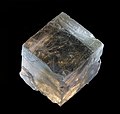
Cubic cleavage occurs on when there are three cleavage planes intersecting at 90 degrees. Halite (or salt) has cubic cleavage, and therefore, when halite crystals are broken, they will form more cubes.Halite
Octahedral cleavage occurs when there are four cleavage planes in a crystal. Fluorite exhibits perfect octahedral cleavage. Octahedral cleavage is common for semiconductors. Diamond also has octahedral cleavage.File:Octahedral Blue Fluorite.JPGFluorite
Rhombohedral cleavage occurs when there are three cleavage planes intersecting at angles that are not 90 degrees. Calcite has rhombohedral cleavage.Calcite
Prismatic cleavage occurs when there are two cleavage planes in a crystal. Spodumene exhibits prismatic cleavage.Spodumene
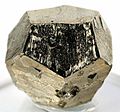
Dodecahedral cleavage occurs when there are six cleavage planes in a crystal. Sphalerite has dodecahedral cleavage.Pyrite
File:NaCl unit cell.jpgThis is a possible unit cell for crystalline NaCl. Credit: Ed Caruthers.
Def. the "smallest repeating structure (parallelepiped) of atoms within a crystal, from which the structure of the complete crystal can be inferred"[14] is called a unit cell.
An examination of the model unit cell for crystalline NaCl shows a repeat pattern along the left front edge starting with a Cl atom at the corner. Moving along the line of atoms at this lowest edge, next is a smaller Na atom, then another Cl atom. This second Cl atom is a repeat of the first.
Going back to the corner Cl atom and moving straight up above it is a Na atom. Above that Na atom is again another Cl that is another repeat of the first.
Looking at the eight corners of this perspective view of the model there is a Cl atom at each corner. Starting again at the lower left corner Cl, directly behind the left rear face of this unit cell is another such unit cell not shown. Further left of these two unit cells are two more. One is along the base diagonal though the corner Cl and the second is in front sharing the face of the model unit cell shown. Counting the model shown there are four unit cells in this layer that share the lower left corner Cl atom.
Right below this layer of four unit cells are four identical unit cells all cornered to this same Cl atom in the lower left corner of the model. Summarizing, the corner of a unit cell is shared by eight unit cells total.
From visualizing nearer unit cells next to the one drawn, an edge of this cell is shared by four unit cells, and each face by two unit cells.
Looking at the numbers of Cls and Nas:
eight corner Cls are each shared by eight unit cells so one corner Cl per unit cell,
along each edge between each corner Cl is a Na, each of 12 edges is shared by four unit cells, so 3 Nas per unit cell,
each face shares a centered Cl with two unit cells, 6 such Cls, each shared by two unit cells, is 3 Cls,
inside the unit cell pictured there is one and only one Na, shared with no other unit cell, so one Na,
totalling the anions, there are 4 Cls, totalling the cations there are 4 Nas. In a unit cell for this model of halite, there are four formula units. The formula content of a unit cell is often denoted as Z. For this model, Z = 4.
Template:Clear
Structures
Even when the mineral grains are too small to see or are irregularly shaped, the underlying crystal structure is always periodic and can be determined by X-ray diffraction.[15] Minerals are typically described by their symmetry content. Crystals are restricted to 32 point groups, which differ by their symmetry. These groups are classified in turn into more broad categories, the most encompassing of these being the six crystal families.[16] All of these six crystal families when combined with the 32 point groups result in 230 space groups that symmetrically describe all space-filling three-dimensional crystal structures.
These families can be described by the relative lengths of the three crystallographic axes, and the angles between them; these relationships correspond to the symmetry operations that define the narrower point groups. They are summarized below; a, b, and c represent the axes, and α, β, γ represent the angle opposite the respective crystallographic axis (e.g. α is the angle opposite the a-axis, viz. the angle between the b and c axes):[16]
The unit cells are specified according to the relative lengths of the cell edges (a, b, c) and the angles between them (α, β, γ). The volume of the unit cell can be calculated by evaluating the triple product Template:Nowrap, where a, b, and c are the lattice vectors. The properties of the lattice systems are given below:
The boundary of the 24-cell is composed of 24 octahedralcells with six meeting at each vertex, and three at each edge. Together they have 96 triangular faces, 96 edges, and 24 vertices. The vertex figure is a cube. The 24-cell is self-dual. In fact, the 24-cell is the unique convex self-dual regular Euclidean polytope which is neither a polygon nor a simplex. It is the only one of the six convex regular 4-polytopes which is not the dimensional analogue of one of the five Platonic solids. It has no regular analogue in 3 dimensions, but it can be considered the analogue of a dual pair of irregular solids: the cuboctahedron and its dual the rhombic dodecahedron.
The 24-cell is the symmetric union of the geometries of every convex regular polytope in the first four dimensions, except those with a 5 in their Schlӓfli symbol.Template:Efn It is especially useful to explore the 24-cell, because one can see all the geometric relationships among all of those polytopes in a single 24-cell or its honeycomb.
The 24-cell is the fourth in the sequence of 6 convex regular 4-polytopes (in order of size and complexity).Template:Efn It can be deconstructed into 3 overlapping instances of its predecessor the tesseract (8-cell), as the 8-cell can be deconstructed into 2 overlapping instances of its predecessor the 16-cell.Template:Sfn The reverse procedure to construct each of these from an instance of its predecessor preserves the radius of the predecessor, but generally produces a successor with a different edge length.Template:Efn
Coordinates
The 24-cell is the convex hull of its vertices. The Cartesian coordinatesTemplate:Sfn of its vertices may be given in several different forms, depending on our choice of coordinate system. Each form of coordinates best illustrates a different aspect of the vertex geometry.
Squares
The 24-cell can be described as the 24 coordinate permutations of:
The 24 vertices can be seen as the vertices of 6 orthogonalTemplate:Efn squaresTemplate:Efn which intersectTemplate:Efn only at the their common center.
Hexagons
The 24-cell is self-dual, having the same number of vertices (24) as cells and the same number of edges (96) as faces.
If the dual of the above 24-cell of edge length Template:Radic is taken by reciprocating it about its inscribed sphere, another 24-cell is found which has edge length and circumradius 1, and its coordinates reveal more structure. In this form the vertices of the 24-cell can be given as follows:
8 vertices obtained by permuting the integer coordinates:
(±1, 0, 0, 0)
and 16 vertices with half-integer coordinates of the form:
The 8 integer coordinates can be seen as the vertices of 6 perpendicularTemplate:Efn squaresTemplate:Efn which intersectTemplate:Efn only at the their common center.
The 24 vertices are the vertices of 4 orthogonal hexagonsTemplate:Efn which intersect only at their common center.Template:Efn
Triangles
The 24 vertices are the vertices of 8 triangles in 4 orthogonal planesTemplate:Efn which intersect only at their common center.
The 24 vertices are also the vertices of 96 other trianglesTemplate:Efn in 48 parallel pairs, in planes one unit length apart which do not pass through the center.Template:Efn
If the 24-cell of edge length and circumradius Template:Radic is taken,Template:Efn its coordinates reveal more structure. In this form the vertices of the 24-cell can be given as follows:
and can be seen to be the vertices of 24 tetrahedraTemplate:Efn inscribed in the 24-cell.Template:Efn
Hypercubic chords
Vertex geometry of the radially equilateralTemplate:Efn 24-cell, showing the 3 great circle polygons and the 4 vertex-to-vertex chord lengths.
Each vertex is joined to 8 othersTemplate:Efn by an edge of length 1, spanning 60° = Template:Sfrac of arc. Next nearest are 6 verticesTemplate:Efn located 90° = Template:Sfrac away, along an interior chord of length Template:Radic. Another 8 vertices lie 120° = Template:Sfrac away, along an interior chord of length Template:Radic. The opposite vertex is 180° = 𝜋 away along a diameter of length 2. Finally, as the 24-cell is radially equilateral, its center can be treatedTemplate:Efn as a 25th canonical apex vertexTemplate:Efn, which is 1 edge length away from all the others.
To visualize how the interior polytopes of the 24-cell fit together (as described below), keep in mind that the four chord lengths (Template:Radic, Template:Radic, Template:Radic, Template:Radic) are the long diameters of the hypercubes of dimensions 1 through 4: the long diameter of the square is Template:Radic; the long diameter of the cube is Template:Radic; and the long diameter of the tesseract is Template:Radic. Moreover, the long diameter of the octahedron is Template:Radic like the square; and the long diameter of the 24-cell itself is Template:Radic like the tesseract.
The Template:Radic edges occur in 16 hexagonal great circles (4 sets of 4 orthogonalTemplate:Efn planes), 4 of which cross at each vertexTemplate:Efn. The 96 distinct Template:Radic edges divide the surface into 96 triangular faces and 24 octahedral cells: a 24-cell.
The Template:Radic chords occur in 18 square great circles (3 sets of 6 orthogonalTemplate:Efn planes), 3 of which cross at each vertexTemplate:Efn. The 72 distinct Template:Radic chords do not run in the same planes as the hexagonal great circles; they do not follow the 24-cell's edges, they pass through its cell centers below one of its mid-edges.Template:Efn
The Template:Radic chords occur in 32 triangular great circles in 16 planes (4 sets of 4 orthogonal planes), 4 of which cross at each vertexTemplate:Efn. The 96 distinct Template:Radic chords run vertex-to-every-other-vertex in the same planes as the hexagonal great circlesTemplate:Efn.
The Template:Radic chords occur as 12 vertex-to-vertex diameters (3 sets of 4 orthogonal axes), the 24 radii around the 25th central vertexTemplate:Efn.
Each great circle plane intersectsTemplate:Efn with each of the other great circle planes or face planes to which it is orthogonal at the center point only, and with each of the others to which it is not orthogonal at a single edge of some kind. In every case that edge is one of the vertex chords of the 24-cell.Template:Efn
Constructions
Triangles and squares come together uniquely in the 24-cell to generate, as interior featuresTemplate:Efn, all of the triangle-faced and square-faced regular convex polytopes in the first four dimensions (with caveats for the 5-cell and the 600-cell).Template:Efn Consequently, there are numerous ways to construct or deconstruct the 24-cell.
Reciprocal constructions from 8-cell and 16-cell
The 8 integer vertices (±1, 0, 0, 0) are the vertices of a regular 16-cell, and the 16 half-integer vertices (±Template:Sfrac, ±Template:Sfrac, ±Template:Sfrac, ±Template:Sfrac) are the vertices of its dual, the tesseract (8-cell). The tesseract gives Gosset's constructionTemplate:Sfn of the 24-cell, equivalent to cutting a tesseract into 8 cubic pyramids, and then attaching them to the facets of a second tesseract. The analogous construction in 3-space gives the rhombic dodecahedron which, however, is not regular. The 16-cell gives the reciprocal construction of the 24-cell, Cesaro's construction,Template:Sfn equivalent to rectifying a 16-cell (truncating its corners at the mid-edges, as described above). The analogous construction in 3-space gives the cuboctahedron (dual of the rhombic dodecahedron) which, however, is not regular. The tesseract and the 16-cell are the only regular 4-polytopes in the 24-cell.Template:Sfn
The vertices of the 24-cell can be grouped into three disjoint sets of eight with each set defining a regular 16-cell, and with the complement defining the dual tesseract.Template:Sfn
Truncations
We can truncateTemplate:Sfn the 24-cell by slicing through planes bounded by vertex chords to remove vertices, exposing the facets of interior 4-polytopes inscribed in the 24-cell. One can cut a 24-cell into two parts through any planar hexagon of 6 vertices, any planar square of 4 vertices, or any planar triangle of 3 vertices. The great circle planes (above) are only some of those planes. Here we shall expose some of the others: the face planes of interior polytopes, which divide the 24-cell into two unequal parts.Template:Efn
8-cell
Starting with a complete 24-cell, remove 8 orthogonal vertices (4 opposite pairs on 4 perpendicular axes), and the 8 edges which radiate from each, by slicing through 24 square face planes bounded by Template:Radic edges to remove 8 cubic pyramids whose apexes are the vertices to be removed. This removes 4 edges from each hexagonal great circle (retaining just one opposite pair of edges), so no continuous hexagonal great circles remain. Now 3 perpendicular edges meet and form the corner of a cube at each of the 16 remaining verticesTemplate:Efn, and the 32 remaining edges divide the surface into 24 square faces and 8 cubic cells: a tesseract. There are three ways you can do this (choose a set of 8 orthogonal vertices out of 24), so there are three such tesseracts inscribed in the 24-cell. They overlap with each other, but most of their element sets are disjoint: they share some vertex count, but no edge length, face area, or cell volume; they do share 4-content.
16-cell
Starting with a complete 24-cell, remove the 16 vertices of a tesseract (retaining the 8 vertices you removed above), by slicing through 32 triangular face planes bounded by Template:Radic chords to remove 16 tetrahedral pyramids whose apexes are the vertices to be removed. This removes 12 square great circles (retaining just one orthogonal set) and all the Template:Radic edges, exposing Template:Radic chords as the new edges. Now the remaining 6 square great circles cross perpendicularly, 3 at each of 8 remaining verticesTemplate:Efn, and their 24 edges divide the surface into 32 triangular faces and 16 tetrahedral cells: a 16-cell. There are three ways you can do this (remove 1 of 3 sets of tesseract vertices), so there are three such 16-cells inscribed in the 24-cell. They do not overlap with each other, and all of their element sets are disjoint: they do not share any vertex count, edge length, face area, cell volume, or 4-content.
5-cell
Starting with a complete 24-cell, remove 20 vertices, by slicing through 4 triangular face planes bounded by Template:Radic chords to remove 5 vertices above each plane.Template:Efn This removes 20 triangular great circles, and all the Template:Radic and Template:Radic chords, exposing Template:Radic chords as the new edges. Now the remaining 4 triangular great circles meet but do not cross, 3 at each of the 4 remaining verticesTemplate:Efn, and their 6 edges divide the surface into 4 non-orthogonal triangle facesTemplate:Efn comprising a single regular tetrahedral cell: a degenerate 5-cell.Template:Efn There are 24 ways you can do this, so there are 24 such tetrahedra inscribed in the 24-cell. They overlap with each other, and all their element sets intersect: they share vertex count, edge length, face area, and cell volume, but have no 4-content to share.
Three tetrahedral constructions
The 24-cell can be constructed radially from 96 equilateral triangles of edge length Template:Radic which meet at the center of the polytope, each contributing two radii and an edge.Template:Efn They form 96 Template:Radic tetrahedra, all sharing the 25th central apex vertex.
The 24-cell can be constructed from 48 equilateral triangles of edge length Template:Radic. They form 48 Template:Radic tetrahedra (the cells of the three 16-cells), centered at the 24 mid-radii of the 24-cell.
The 24-cell can be constructed from 32 equilateral triangles of edge length Template:Radic centered at the 25th central apex vertex.Template:Efn The edges of these triangles form 96 other equilateral triangles centered at the 24 mid-radii of the 24-cell.Template:Efn These form the faces of 24 Template:Radic tetrahedra (the degenerate 5-cells), centered at the 25th central apex vertex.Template:Efn
Relationships among interior polytopes
The 24-cell, three tesseracts, three 16-cells and 24 degenerate 5-cells are deeply entwined around their common center. The tesseracts are inscribed in the 24-cell such that their vertices and edges lie on the surface of the 24-cell (they are elements of the 24-cell), but their square faces and cubical cells lie inside the 24-cell (they are not elements of the 24-cell). The 16-cells are inscribed in the 24-cell such that only their vertices lie on the surface: their edges, triangular faces, and tetrahedral cells lie inside the 24-cell. The interiorTemplate:Efn 16-cell edges have length Template:Radic. The 5-cells are inscribed in the 24-cell such that only four of their five vertices lie on the surface: their fifth vertex is the center of the 24-cell, and all their edges, triangular faces and tetrahedral cells lie inside the 24-cell.
Kepler's drawing of tetrahedra inscribed in the cube.Template:Sfn
The 16-cells are also inscribed in the tesseracts: their Template:Radic edges are the face diagonals of the tesseract, and their 8 vertices occupy every other vertex of the tesseract. Each tesseract has two 16-cells inscribed in it (occupying the opposite vertices and face diagonals), so each 16-cell is inscribed in two of the three 8-cells. This is reminiscent of the way, in 3 dimensions, two tetrahedra can be inscribed in a cube, as discovered by Kepler.Template:Sfn In fact it is the exact dimensional analogy (the demihypercubes), and the 48 tetrahedral cells are inscribed in the 24 cubical cells in just that way.Template:Sfn
The degenerate 5-cells are each both a regular tetrahedron and an irregular 5-cell. Their 6 long Template:Radic edges are each also a long diagonal of a cube (in two different tesseracts). Their 4 short Template:Radic edges are each also a long radius of the 24-cell (and therefore also a long radius of two different tesseracts). Each Template:Radic tetrahedral face triangleTemplate:Efn has one edge entirely in each tesseract, and one vertex in each 16-cell. Only one of the tetrahedral vertices is one end of a coordinate system axis;Template:Efn thus each tetrahedron is spindled on just one of the four coordinate axes.Template:Efn
The 24-cell encloses the three tesseracts within its envelope of octahedral facets, leaving 4-dimensional space in some places between its envelope and each tesseract's envelope of cubes. Each tesseract encloses two of the three 16-cells, leaving 4-dimensional space in some places between its envelope and each 16-cell's envelope of tetrahedra. Thus there are measurableTemplate:Sfn 4-dimensional intersticesTemplate:Efn between the 24-cell, 8-cell, 16-cell and 5-cell envelopes.Template:Efn The shapes filling these gaps are 4-pyramidsTemplate:Efn, alluded to above.
Boundary cells
Despite the 4-dimensional interstices between 24-cell, 8-cell, 16-cell and 5-cell envelopes, their 3-dimensional volumes overlap. The different envelopes are separated in some places, and in contact in other places (where no 4-pyramid lies between them). Where they are in contact, they merge and share cell volume: they are the same 3-membrane in those places, not two separate but adjacent 3-dimensional layers. Because there are a total of 31 envelopes, there are places where several envelopes come together and merge volume, and also places where envelopes interpenetrate (cross from inside to outside each other).
Some interior features lie inside the (outer) boundary envelope of the 24-cell itself: each octahedral cell is bisected by three perpendicular squares (one from each of the tesseracts), and the diagonals of those squares (which cross each other perpendicularly at the center of the octahedron) are 16-cell edges (one from each 16-cell). Each square bisects an octahedron into two square pyramids, and also bonds two adjacent cubic cells of a tesseract together as their common face.
As we saw above, 16-cell Template:Radic tetrahedral cells are inscribed in tesseract Template:Radic cubic cells, sharing the same volume. 24-cell Template:Radic octahedral cells overlap their volume with Template:Radic cubic cells: they are bisected by a square face into two square pyramids,Template:Sfn the apexes of which also lie at a vertex of a cube.Template:Efn The octahedra share volume not only with the cubes, but with the tetrahedra inscribed in them; thus the 24-cell, tesseracts, and 16-cells all share some boundary volume.Template:Efn
Configuration
This configuration matrixTemplate:Sfn represents the 24-cell. The rows and columns correspond to vertices, edges, faces, and cells. The diagonal numbers say how many of each element occur in the whole 24-cell. The non-diagonal numbers say how many of the column's element occur in or at the row's element.
Since the 24-cell is self-dual, its matrix is identical to its 180 degree rotation.
Radially equilateral honeycomb
The tessellation of 4-dimensional Euclidean space by regular 24-cells exists; it is called the 24-cell honeycomb. Each 24-cell of this tessellation has 24 neighbors with which it shares an octahedron. It also has 24 other neighbors with which it shares only a single vertex. Eight 24-cells meet at any given vertex in this tessellation. It is one of only three regular tessellations of R4. The unit balls inscribed in the 24-cells of this tessellation give rise to the densest known lattice packing of hyperspheres in 4 dimensions. The vertex configuration of the 24-cell has also been shown to give the highest possible kissing number in 4 dimensions.
The dual tessellation of the 24-cell honeycomb {3,4,3,3} is the 16-cell honeycomb {3,3,4,3}. The third regular tessellation of four dimensional space is the tesseractic honeycomb {4,3,3,4}, whose vertices can be described by 4-integer Cartesian coordinates. The congruent relationships among these three tessellations can be helpful in visualizing the 24-cell, in particular the radial equilateral symmetry which it shares with the tesseract.Template:Efn
A honeycomb of unit-edge-length 24-cells may be overlaid on a honeycomb of unit-edge-length tesseracts such that every vertex of a tesseract (every 4-integer coordinate) is also the vertex of a 24-cell (and tesseract edges are also 24-cell edges), and every center of a 24-cell is also the center of a tesseract. The 24-cells are twice as large as the tesseracts by 4-dimensional content (hypervolume), so overall there are two tesseracts for every 24-cell, only half of which are inscribed in a 24-cell. If those tesseracts are colored black, and their adjacent tesseracts (with which they share a cubical facet) are colored red, a 4-dimensional checkerboard results.Template:Sfn Of the 24 center-to-vertex radiiTemplate:Efn of each 24-cell, 16 are also the radii of a black tesseract inscribed in the 24-cell. The other 8 radii extend outside the black tesseract (through the centers of its cubical facets) to the centers of the 8 adjacent red tesseracts. Thus the 24-cell honeycomb and the tesseractic honeycomb coincide in a special way: 8 of the 24 vertices of each 24-cell do not occur at a vertex of a tesseract (they occur at the center of a tesseract instead). Each black tesseract is cut from a 24-cell by truncating it at these 8 vertices, slicing off 8 cubic pyramids (as in reversing Gosset's construction,Template:Sfn but instead of being removed the pyramids are simply colored red and left in place). Eight 24-cells meet at the center of each red tesseract: each one meets its opposite at that shared vertex, and the six others at a shared octahedral cell.
The red tesseracts are filled cells (they contain a central vertex and radii); the black tesseracts are empty cells. The vertex set of this union of two honeycombs includes the vertices of all the 24-cells and tesseracts, plus the centers of the red tesseracts. Adding the 24-cell centers (which are also the black tesseract centers) to this honeycomb yields a 16-cell honeycomb, the vertex set of which includes all the vertices and centers of all the 24-cells and tesseracts. The formerly empty centers of adjacent 24-cells become the opposite vertices of a unit-edge-length 16-cell. 24 half-16-cells (octahedral pyramids) meet at each formerly empty center to fill each 24-cell, and their octahedral bases are the 6-vertex octahedral facets of the 24-cell (shared with an adjacent 24-cell).
Rotations
There are three distinct orientations of the tesseractic honeycomb which could be made to coincide with the 24-cell honeycomb in this manner, depending on which of the 24-cell's three disjoint sets of 8 orthogonal vertices (which set of 4 perpendicular axes) was chosen to align it, just as three tesseracts can be inscribed in the 24-cell, rotated with respect to each other. The distance from one of these orientations to another is an isoclinic rotation through 45 degrees (a double rotation of 45 degrees in each of two orthogonal axes planes, around a single fixed point).Template:Efn


_1_(17307955385).jpg)


-Stilbite-Ca-Heulandite-Ca-226327.jpg)


.jpg)


.jpg)