File:Classical Kepler orbit e0.6.gif
Jump to navigation
Jump to search
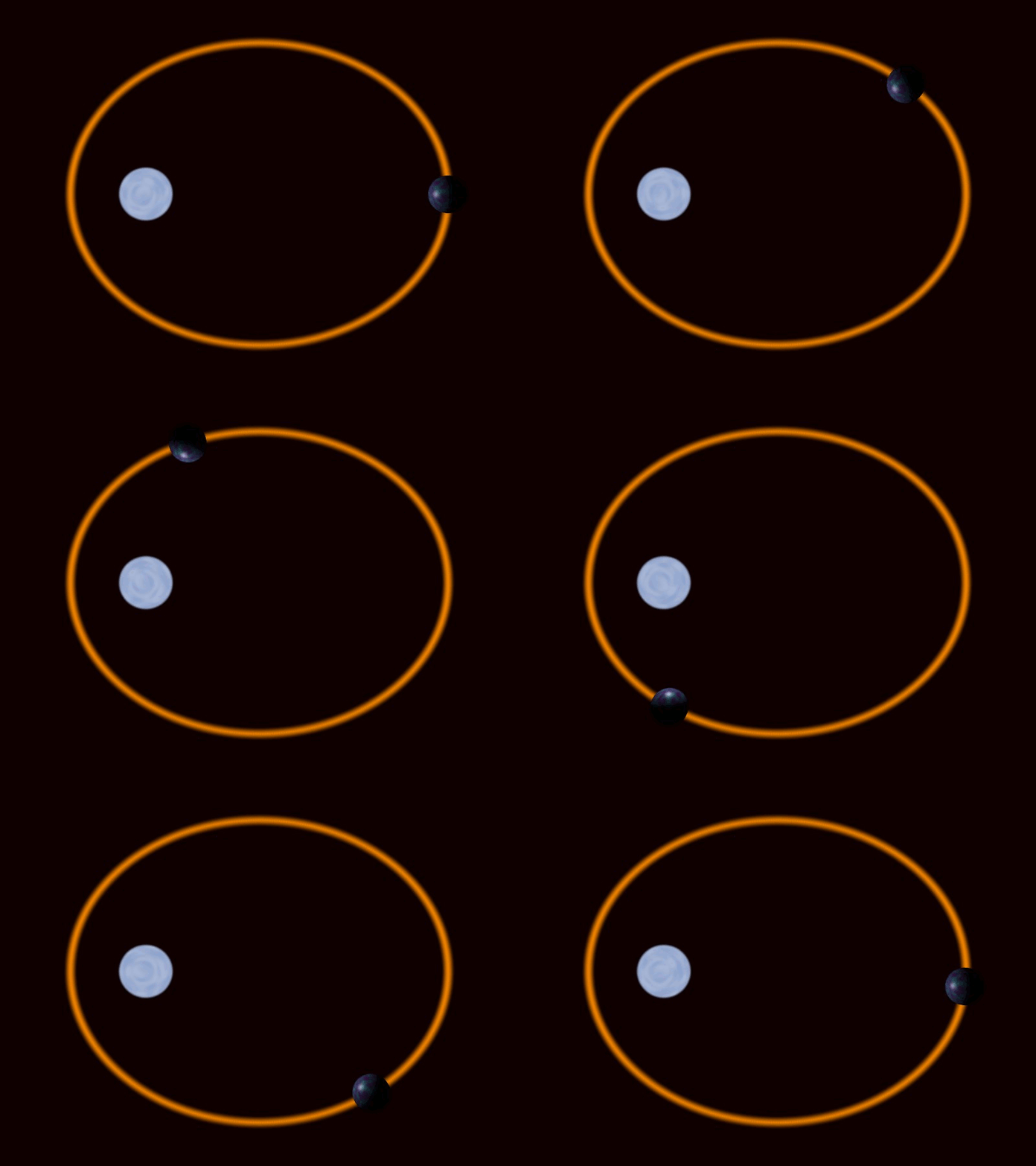
No higher resolution available.
Classical_Kepler_orbit_e0.6.gif (800 × 600 pixels, file size: 1.46 MB, MIME type: image/gif, looped, 40 frames, 1.6 s)
Note: Due to technical limitations, thumbnails of high resolution GIF images such as this one will not be animated.

Summary
| Description | GIF animation of a Kepler orbit with eccentricity 0.6. Once perfected, this will be the basis of several related animations for orbital precession, Newton's theorem of revolving orbits and the Laplace-Runge-Lenz vector. |
| Date | |
| Source | I made this image using Blender and the classical Kepler equations using the eccentric anomaly, described in the classical mechanics textbook of Herbert Goldstein. The numerical values of the radius and angle as a function of time were calculated by my own GPL computer program. |
| Author | Willow |
 This animation was created with Blender by GIF.
Licensing
I, the copyright holder of this work, hereby publish it under the following licenses:

|
Permission is granted to copy, distribute and/or modify this document under the terms of the GNU Free Documentation License, Version 1.2 or any later version published by the Free Software Foundation; with no Invariant Sections, no Front-Cover Texts, and no Back-Cover Texts. A copy of the license is included in the section entitled GNU Free Documentation License. |


This file is licensed under the Creative Commons Attribution 3.0 Unported license.
- You are free:
- to share – to copy, distribute and transmit the work
- to remix – to adapt the work
- Under the following conditions:
- attribution – You must give appropriate credit, provide a link to the license, and indicate if changes were made. You may do so in any reasonable manner, but not in any way that suggests the licensor endorses you or your use.
You may select the license of your choice.
File history
Click on a date/time to view the file as it appeared at that time.
| Date/Time | Thumbnail | Dimensions | User | Comment | |
|---|---|---|---|---|---|
| current | 10:39, 11 January 2008 | | 800 × 600 (1.46 MB) | wikimediacommons>WillowW | {{Information |Description=GIF animation of a Kepler orbit with eccentricity 0.6. Once perfected, this will be the basis of several related animations for orbital precession, Newton's theorem of revolving orbits and the Laplace-Runge-Lenz vector. |Source |
File usage
The following 5 pages use this file:
