File:Hubble Space Telescope Image of Fragment BDGLNQ12R Impacts.jpg
Jump to navigation
Jump to search

Size of this preview: 463 × 599 pixels. Other resolutions: 185 × 240 pixels | 612 × 792 pixels.
Original file (612 × 792 pixels, file size: 158 KB, MIME type: image/jpeg)
| Description |
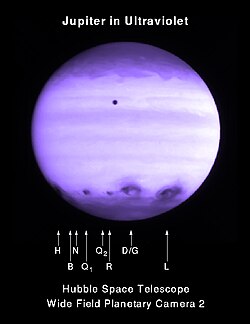
English: Ultraviolet image of Jupiter taken by the Wide Field Camera of the Hubble Space Telescope. The image shows Jupiter's atmosphere at a wavelength of 2550 Angstroms after many impacts by fragments of comet Shoemaker-Levy 9. The most recent impactor is fragment R which is below the center of Jupiter (third dark spot from the right). This photo was taken 3:55 EDT on July 21, about 2.5 hours after R's impact. A large dark patch from the impact of fragment H is visible rising on the morning (left) side. Proceding to the right, other dark spots were caused by impacts of fragments Q1, R, D and G (now one large spot), and L, with L covering the largest area of any seen thus far. Small dark spots from B, N, and Q2 are visible with careful inspection of the image. The spots are very dark in the ultraviolet because a large quantity of dust is being deposited high in Jupiter's stratosphere, and the dust abosrbs sunlight. The dark circle on the upper half is the moon Io in front of Jupiter.
Deutsch: 1994: Jupiter nach dem Einschlag von Shoemaker-Levy 9, UV-Aufnahme -
UV-Bild vom Jupiter aufgenommen mit der Wide Field Camera des Hubble Weltraumteleskops. Es zeigt die Atmosphäre des Planeten nach vielen Einschlägen von Bruchstücken des Kometen Shoemaker-Levy 9 in der Wellenlänge 2550Å. Der jüngste Einschlag auf dem Bild ist Fragment R (dritter dunkler Fleck von rechts). Das Foto wurde am 21. Juli um 3:55 EDT aufgenommen, etwa 2,5 Stunden nach dem Einschlag von R. Links ist ein großes dunkles Gebiet zu sehen, das gerade auf der Morgenseite aufgeht. Nach rechts weitergehend wurden weitere dunkle Flecken durch Einschläge der Bruchstücke Q1, R, D/G (nunmehr ein einziger großer Fleck) und L, wobei L das bislang größte Ausmaß hat. Bei genauer Betrachtung des Bildes sind kleine dunkle Flecken von B, N und Q2 zu erkennen. Die Flecken sind im UV-Bereich sehr dunkel, da eine große Menge Staub hoch oben in Jupiters Stratosphäre getragen wird, und dieses Sonnenlicht absorbiert. Der dunkle Punkt oberhalb ist der vor dem Jupiter vorbeiziehende Mond Io. |
| Date | |
| Source |
http://www2.jpl.nasa.gov/sl9/image129.html http://www2.jpl.nasa.gov/sl9/gif/hst19.gif |
| Author | NASA/STScI Hubble Space Telescope Comet Team |
| Other versions |
|
.jpg)
.jpg)



Licensing

|
This file is in the public domain because it was created by NASA and ESA. NASA Hubble material (and ESA Hubble material prior to 2009) is copyright-free and may be freely used as in the public domain without fee, on the condition that only NASA, STScI, and/or ESA is credited as the source of the material. This license does not apply if ESA material created after 2008 or source material from other organizations is in use.
The material was created for NASA by Space Telescope Science Institute under Contract NAS5-26555, or for ESA by the Hubble European Space Agency Information Centre. Copyright statement at hubblesite.org or 2008 copyright statement at spacetelescope.org. For material created by the European Space Agency on the spacetelescope.org site since 2009, use the {{ESA-Hubble}} tag. |
File history
Click on a date/time to view the file as it appeared at that time.
| Date/Time | Thumbnail | Dimensions | User | Comment | |
|---|---|---|---|---|---|
| current | 00:42, 9 May 2015 | | 612 × 792 (158 KB) | wikimediacommons>Jcpag2012 | better quality using GIMP |
File usage
The following page uses this file:
