PlanetPhysics/2DFT Imaging
Two-dimensional Fourier transform imaging
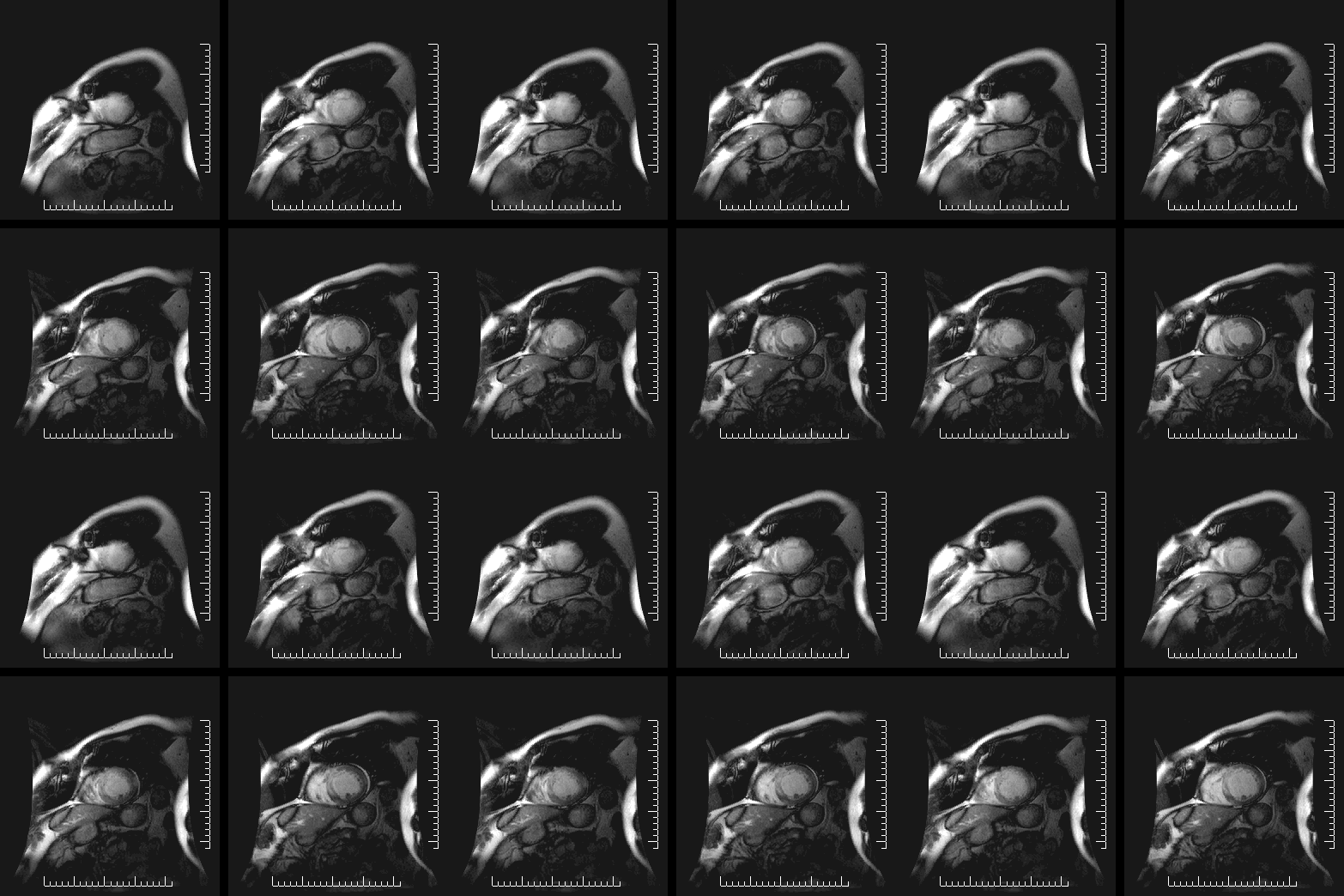
A [[../2DFFT/|two-dimensional Fourier transform]] (2D-FT) is computed numerically or carried out in two stages, both involving `standard', one-dimensional [[../FourierTransforms/|Fourier transforms]]. However, the second stage Fourier transform is not the inverse Fourier transform (which would result in the original [[../Bijective/|function]] that was transformed at the first stage), but a Fourier transform in a second variable-- which is `shifted' in value-- relative to that involved in the result of the first Fourier transform. Such 2D-FT analysis is a very powerful method for three-dimensional reconstruction of polymer and biopolymer structures by [[../CoriolisEffect/|two-dimensional]] Nuclear Magnetic [[../QualityFactorOfAResonantCircuit/|resonance]] (2D-FT NMR , [1]) of solutions for molecular weights () of the dissolved polymers up to about 50,000 . For larger biopolymers or polymers, more complex methods have been developed to obtain the desired resolution needed for the 3D-reconstruction of higher [[../FCS3/|molecular structures]], e.g. for , methods that can also be utilized in vivo . The 2D-FT method is also widely utilized in optical spectroscopy, such as 2D-FT [[../SpectralImaging/|NIR]] [[../SpectralImaging/|Hyperspectral Imaging]], or in MRI imaging for research and clinical, diagnostic applications in Medicine.
A more precise mathematical definition of the `double' Fourier transform involved is specified next, and a precise example follows the definition.
A 2D-FT, or two-dimensional Fourier transform, is a standard Fourier transformation of a function of two variables, , carried first in the first variable , followed by the Fourier transform in the second variable of the resulting function . (For further specific details and example for 2D-FT Imaging v. URLs provided in the following recent Bibliography).
Example 0.1 A 2D Fourier transformation and phase correction is applied to a set of 2D [[../MolecularOrbitals/|NMR]] (FID) signals yielding a real 2D-FT [[../MolecularOrbitals/|NMR `spectrum]]' (collection of 1D [[../MolecularOrbitals/|FT-NMR]] spectra) represented by a [[../Matrix/|matrix]] whose elements are where and denote the discrete indirect double-quantum and single-quantum([[../MolecularOrbitals/|detection]]) axes, respectively, in the 2D NMR experiments. Next, the [[../Covariance/|covariance]] matrix is calculated in the frequency [[../Bijective/|domain]] according to the following equation:
with taking all possible single-quantum frequency values and with the summation carried out over all discrete, double quantum frequencies .\\
Example 0.2
Atomic structure reconstruction by 2D-FT of STEM Images(obtained at Cornell University) reveals the electron distributions in a high-temperature cuprate superconductor `paracrystal'; both the domains (or `location') and the local symmetry of the "pseudo-gap" are seen in the electron-pair correlation band responsible for the high--temperature [[../QuantumStatisticalTheories/|superconductivity]] effect .
Remarks
So far there have been three Nobel prizes awarded for 2D-FT NMR/MRI during 1992-2003, and an additional, earlier Nobel prize for 2D-FT of [[../FluorescenceCrossCorrelationSpectroscopy/|X-ray]] data (`CAT scans'); recently the advanced possibilities of 2D-FT techniques in Chemistry, Physiology and Medicine received very significant recognition.
All Sources
[1] [2] [3] [4] [5] [6] [7] [8]
References
- ↑ 1.0 1.1 Kurt W\"{u}trich: 1986, NMR of Proteins and Nucleic Acids. , J. Wiley and Sons: New York, Chichester, Brisbane, Toronto, Singapore. (Nobel Laureate in 2002 for 2D-FT NMR Studies of Structure and Function of Biological Macromolecules); 2D-FT NMR Instrument Image Example: a JPG color image of a 2D-FT NMR Imaging `monster' Instrument
- ↑ Richard R. Ernst. 1992. Nuclear Magnetic Resonance Fourier Transform (2D-FT) Spectroscopy. Nobel Lecture, on December 9, 1992.
- ↑ Peter Mansfield. 2003. Nobel Laureate in Physiology and Medicine for (2D and 3D) MRI.
- ↑ D. Benett. 2007. PhD Thesis . Worcester Polytechnic Institute. (lots of 2D-FT images of mathematical, brain scans .) PDF of 2D-FT Imaging Applications to MRI in Medical Research.
- ↑ Paul Lauterbur. 2003. Nobel Laureate in Physiology and Medicine for (2D and 3D) MRI.
- ↑ Jean Jeener. 1971. Two-dimensional Fourier Transform NMR, presented at an Ampere International Summer School, Basko Polje, unpublished . A verbatim quote follows from Richard R. Ernst's Nobel Laureate Lecture delivered on December 2nd, 1992, A new approach to measure two-dimensional (2D) spectra has been proposed by Jean Jeener at an Amp\`ere Summer School in Basko Polje, Yugoslavia, 1971 (). He suggested a 2D Fourier transform experiment consisting of two pulses with a variable time between the pulses and the time variable measuring the time elapsed after the second pulse as shown in Fig. 6 that expands the principles of Fig. 1. Measuring the response of the two-pulse sequence and Fourier-transformation with respect to both time variables produces a two-dimensional spectrum of the desired form. This two-pulse experiment by Jean Jeener is the forefather of a whole class of experiments that can also easily be expanded to multidimensional spectroscopy.
- ↑ A 2D-FT NMRI article and Spectroscopy.
- ↑ Cardiac infarct movies by 2D-FT NMR Imaging

Cite error: <ref> tag with name "JeanJeneer1971" defined in <references> group "" has no content.